← CrateGhost preview · EgoB software
From record to sample flip.
Development alpha · Public download and pricing not yet available.
Install CrateGhost, explore a recording, shape your chops and export a pattern. Start with the built-in demo to hear the workflow.
Development preview
Current Mac package: CrateGhost-0.3.0-macOS-arm64.zip. The current Windows package is CrateGhost-0.3.0-Windows-x64.msi. This guide covers the Mac package. Public downloads and purchases are not yet available.
1. Install on your Mac
This package requires Apple Silicon and macOS 14 or later. It includes a standalone app and a VST3 instrument.
- Extract the complete ZIP in Finder. Keep the installer scripts beside the app and plug-in.
- Save your work and quit older copies of CrateGhost and any DAW using it.
- Double-click install.command. Terminal installs the app to
~/Applicationsand the plug-in to~/Library/Audio/Plug-Ins/VST3. Existing copies with the same names are replaced; your projects and preferences remain. - In Finder, choose Go → Go to Folder, enter
~/Applicationsand open CrateGhost. - Use the standalone Options menu to choose your audio output and MIDI device.
If the installer does not open, open Terminal, type bash followed by a space, drag install.command into Terminal and press Return.
This local alpha is ad-hoc signed and not notarized. If macOS blocks a build you trust, use its per-app approval in System Settings → Privacy & Security. See README-FIRST.txt in the extracted folder for installation and approval details.
To uninstall, quit the app and affected DAWs, then run uninstall.command. Your projects, preferences and licenses are retained. For an all-users installation, run bash ./install.command --system from the extracted folder; administrator authentication is required. Use the same --system option when uninstalling.
2. Make your first flip
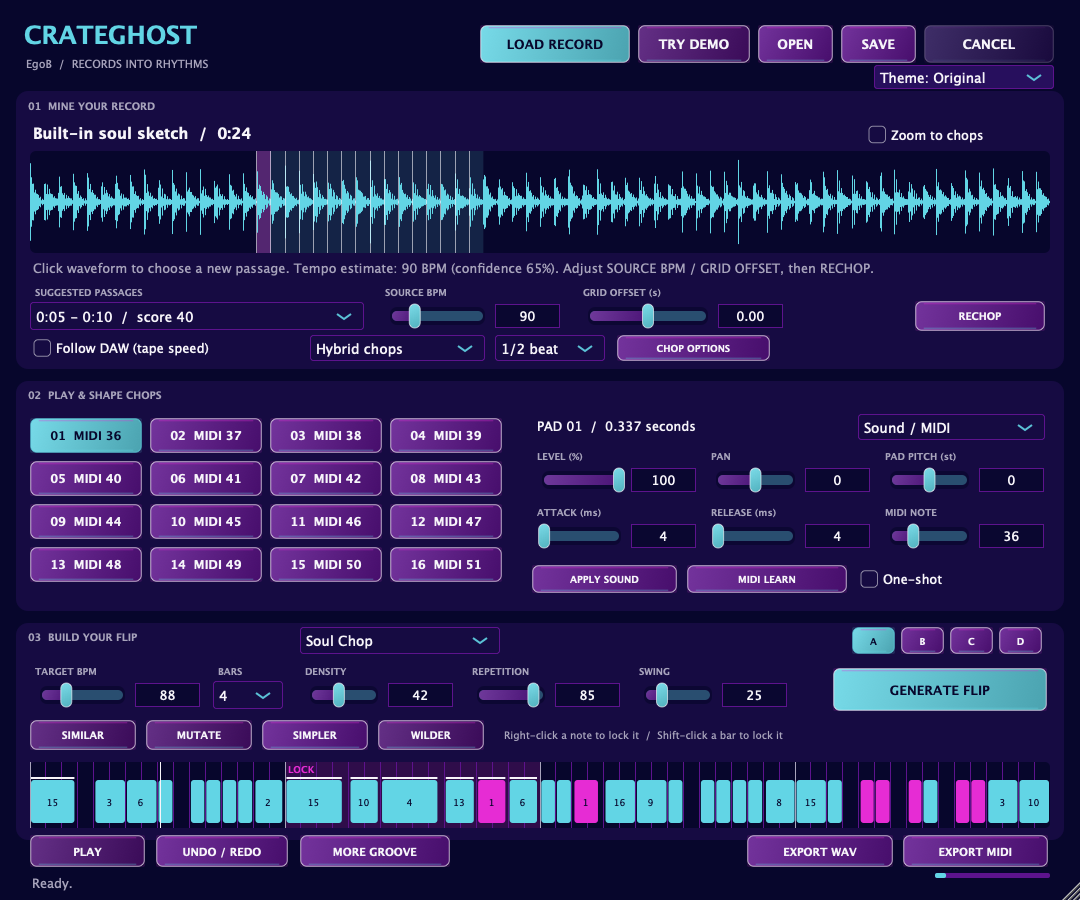
- Click TRY DEMO for an original synthetic example. Or click LOAD RECORD / drop an audio file into the editor.
- Review the suggested passages. Click the waveform to move the sampling region; use Zoom to chops to inspect it.
- Check SOURCE BPM and GRID OFFSET. Correct them if necessary, then click RECHOP.
- Click the pads to audition your slices.
- Choose a style, target BPM, 1/2/4/8 bars, density, repetition and swing.
- Click GENERATE FLIP, then PLAY.
Loading a recording or choosing a style does not generate a pattern. Generation controls apply when you click GENERATE FLIP; each click uses a new seed.
Try Classic Boom Bap, Dusty, Soul Chop, Jazz Chop, Sparse, Heavy Stabs, Smooth Loop or Micro Chop. The Theme menu changes the appearance between Original, Graphite and Copper without changing the music.
3. Shape the chops and groove
Choose Hybrid, Grid, Transient or Phrase chopping and a grid division. Open CHOP OPTIONS for transient sensitivity, minimum/maximum length and zero-crossing alignment; apply your changes with RECHOP. Transient and Phrase may leave some pads empty; generation skips them.
Select a pad, adjust its start/end or reverse, then click APPLY TRIM. On Sound / MIDI, edit level, pan, tape pitch, attack, release, gate/one-shot and MIDI note; click APPLY SOUND.
MIDI LEARN assigns the next incoming note to the selected pad. Defaults are notes 36–51 on any MIDI channel. Assigning a note already in use swaps the two assignments. Pads share one choke group: triggering a new pad cuts off the previous one. Gate mode releases at note-off; One-shot continues until completion or choke.
MORE GROOVE opens syncopation, timing/velocity humanisation, short/long chop bias and dropout controls. Apply those settings, then generate again.
Tape pitch changes both pitch and duration. Releasing the target tempo or global tape-pitch slider re-renders the current pattern. Independent time stretching is not included.
4. Edit and keep variations
Click a pattern step to remove its event or add the selected pad. UNDO / REDO toggles between the last two completed musical states.
| Control | What it does |
|---|---|
| SIMILAR | Changes some velocities and pads within the existing vocabulary while retaining timing and note lengths. |
| MUTATE | Also changes some note lengths and may use other active pads. |
| SIMPLER | Removes alternate unlocked events. |
| WILDER | Mutates the pattern and adds events where gaps allow. |
| A / B / C / D | Switches ideas and retains the departing pattern. An empty slot begins as a copy. |
Right-click a note to lock/unlock it. Shift-click a bar to lock/unlock its events and rests. Generate and variations preserve locks. Unlock affected material before shortening a pattern or rechopping away its pads.
Slots retain notes, bar count, seed and locks. Source, pad sounds, tempo and generation controls are shared. Switching slots prepares audio in the background and restarts internal playback at the beginning.
5. Save and export
- SAVE creates a
.crateghostproject; OPEN restores it. Keep your original recording with your project. If its original path is missing, CrateGhost also looks beside the project for the same filename and checks the audio identity. - EXPORT WAV writes the selected pattern as stereo 44.1 kHz / 24-bit audio.
- EXPORT MIDI writes channel-1 pad triggers with tempo and 4/4 meter. MIDI contains no audio: play it through CrateGhost with the matching project loaded and internal playback stopped.
Exports render the selected pattern rather than a live pad performance. The package’s Example folder includes a demo project, WAV flip and MIDI. Opening the demo project reconstructs its synthetic source internally.
CANCEL stops background preparation and keeps the previous completed result.
6. Use CrateGhost in a DAW
- Run the installer, restart your DAW and rescan VST3 plug-ins if needed.
- Load CrateGhost as an instrument on a MIDI/instrument track.
- Load a recording or saved project. Trigger pads from MIDI, or use the internal generated pattern.
Follow DAW (tape speed) follows the host’s quarter-note position and tempo. A host tempo different from TARGET BPM changes both speed and pitch. To retain the original pitch at another tempo, set TARGET BPM to the host tempo before enabling Follow DAW. In standalone mode, leave Follow DAW off and use PLAY.
If something is not working
- No sound?
- Check the standalone audio output in Options, load the demo and audition a pad. For a generated pattern, click GENERATE FLIP before PLAY. In a DAW, check the instrument track’s monitoring and audio routing.
- Chops miss the beat?
- Correct SOURCE BPM and GRID OFFSET, then RECHOP. Beat-aligned slicing assumes a steady tempo and 4/4; drifting recordings may need manual region and trim edits.
- A variation changes nothing?
- Check your event/bar locks. A fully locked pattern can legitimately remain unchanged.
- The plug-in is missing?
- Check that the complete CrateGhost.vst3 bundle is in your user VST3 folder. Restart/rescan in a DAW that supports VST3 and Apple Silicon plug-ins. This package does not contain an Audio Unit.
- A recording will not load?
- Use WAV, AIFF, FLAC or MP3, mono/stereo, 8–192 kHz, between 0.25 seconds and 10 minutes, within the 256 MiB decoded-audio limit. A saved project rejects changed source audio.
This development alpha provides up to sixteen chops, monophonic flip playback and four pattern slots. It does not include independent time stretching, source separation or generated drums. Engine, workflow and JUCE VST3 host tests passed for this Mac build; third-party DAW qualification remains separate.